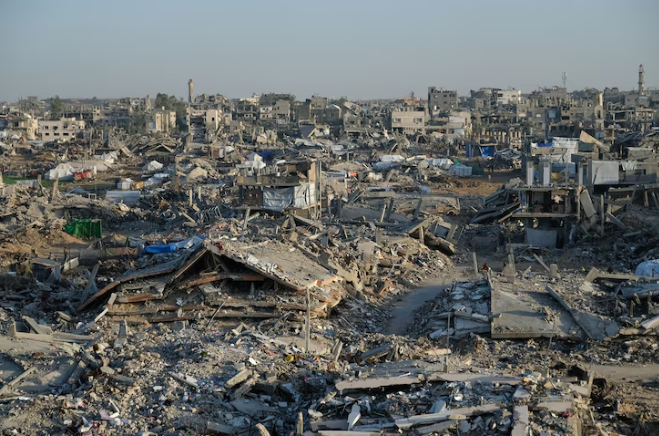
The ceasefire in Gaza is broadly holding, with Israeli forces inside the strip having pulled back to the so-called “yellow line.” Israel Defense Forces chief Eyal Zamir said the position constitutes “a new border line” with Gaza.
Sporadic clashes between the Israel Defense Forces and Gaza militants — plus deadly IDF airstrikes — continue despite the ceasefire, which is still in the first of three proposed phases. The details of the second phase of the agreement are yet to be agreed.
Israeli strikes are also ongoing against alleged Hezbollah targets in southern and eastern Lebanon.
IDF chief says ‘yellow line’ is ‘a new border line’ in Gaza
Israel Defense Forces chief Eyal Zamir addressed troops in Gaza on Sunday, referring to the “yellow line” currently splitting Gaza in half as a “new border line.”

“We will not allow Hamas to reestablish itself,” Zamir said. “We have operational control over extensive parts of the Gaza Strip and we will remain on those defense lines. The yellow line is a new border line — serving as a forward defensive line for our communities and a line of operational activity.”
Israeli forces withdrew to the yellow line in October as part of the ceasefire deal with Hamas. That partial withdrawal left Israeli forces in control of more than half of the strip.
The yellow line was intended as the first of three demarcation lines, to which Israeli forces would withdraw as the ceasefire progressed through its three stages.
In a joint press conference with German Chancellor Friedrich Merz in Jerusalem on Sunday, Prime Minister Benjamin Netanyahu reiterated that Israel cannot accept a Palestinian state.
He stressed that Israel will retain full security control from the Jordan River to the Mediterranean, rejecting any arrangement that would allow a Palestinian state to threaten its existence.
“The goal of a Palestinian state is to destroy the only Jewish state. They already had a state in Gaza, a de facto state, and it was used to try to destroy the only Jewish state,” Netanyahu said.
While he said broader peace with Arab states remains possible, Netanyahu added that Israel will not agree to the creation of a state that will “commit to the destruction” of Israel at its doorstep. He also warned of a resurgence in global antisemitism and defended Israel’s military actions as a response to existential threats from Iran and its proxies.
Netanyahu highlighted a historic shift in Israel–Germany relations, noting that 80 years after the Holocaust, Israel is now helping to defend Germany – a historic change, as he described it.
Answering press questions, when asked if he would leave politics in exchange for a pardon, Netanyahu responded in Hebrew: “No, no.”
Regarding the second phase of the peace plan, he emphasized that Hamas must disarm and said the second phase of the peace plan is “close.”
“We’ll be having very important conversations at the end of the month on how to ensure that this second stage is achieved,” Netanyahu said, referring to his planned visit to the White House to meet President Trump at the end of the month.