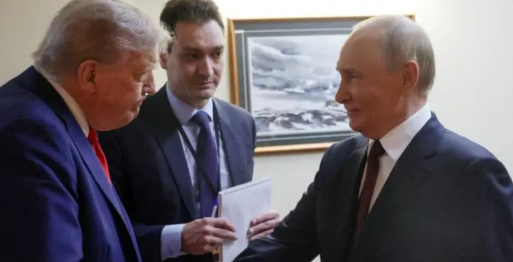
A former US ambassador to Ukraine has urged Western leaders to put more pressure on Russian President Vladimir Putin.
William B Taylor says Putin is trying to “wait out” Ukraine, Europe and the United States, in order to secure a favourable deal for Russia.
“If we hang tough then we can force him to come to the table, but we haven’t done that,” he tells Radio 4’s Today programme.
Taylor adds that the “Putin problem is one President Trump didn’t truly appreciate” until now.
A former UK ambassador to Russia has warned that reaching agreement on “security guarantees” for Ukraine is likely to prove difficult.
The initial 28-point peace plan said there would be Western-backed security guarantees for Ukraine, in order to deter future Russian aggression.
But the plan also required Ukraine to commit to not joining Nato – the military alliance of Western nations. It’s unclear whether this requirement still remains in place, after German foreign minister
The UK’s former ambassador to Russia, Sir Tony Brenton, says he’s heard that one of the “principal complications” continues to be around those security guarantees for Ukraine.
“The Russians are very suspicious of any sort of guarantee which will amount in their view to Ukraine joining Nato by the back door,” he explains.

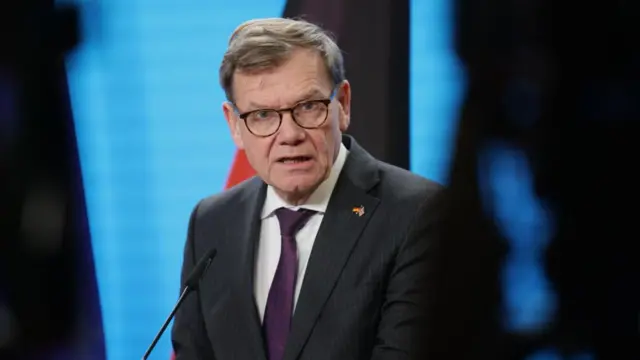
The talks between the US and Ukraine in Geneva have produced “decisive success” for Europeans, says the German foreign minister.
Johann Wadephul says issues concerning Europe, including an apparent ban on Ukraine joining Nato, have been removed from the 28-point peace plan.
“This is a decisive success that we achieved yesterday,” he tells Germany’s public-broadcasting radio station, Deutschlandfunk.
The German foreign minister also reiterated that “any agreement must not be reached over the heads of Europeans and Ukrainians”.
As a reminder, we have yet to see the 28-point plan in full – or the “revisions and clarifications” that were, according to the US, agreed on Sunday.
Overnight, the White House said talks with Ukraine on a peace deal with Russia were “extensive and productive”.
In a statement, the US administration said Ukraine’s officials recognised that “all of their principal concerns” – including security guarantees and political sovereignty – had been “thoroughly addressed” during the meeting.
The statement said there had been “revisions and clarifications” to the initial 28-point plan.

“They [Ukrainian officials] believe the current draft reflects their national interests and provides credible and enforceable mechanisms to safeguard Ukraine’s security in both the near and long term,” the US said.
“Both sides welcomed the steady progress made and agreed to continue consultations as the agreements move toward final refinement.”
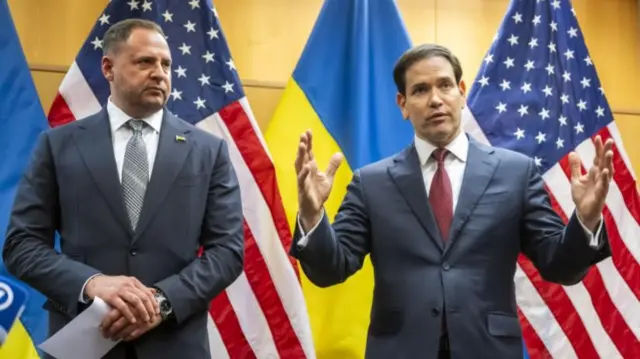
The White House statement followed remarks by US Secretary of State Marco Rubio, who told reporters “tremendous progress” had been made on reaching a peace deal.
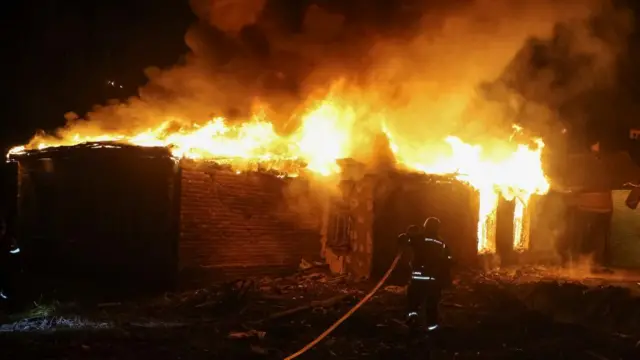
As peace talks progressed in Geneva, Russian attacks on Ukraine continued on Sunday.
Russian drones struck the eastern city of Kharkiv, according to Ukraine’s State Emergency Service.
Four people died with another 17 wounded, according to the city’s mayor Igor Terekhov.
“The circumstances are truly horrible when, despite the negotiations, Russian troops are attacking civilian objects, civilian infrastructure, residential buildings, when people are dying – this is horror,” Terekhov wrote on Telegram.
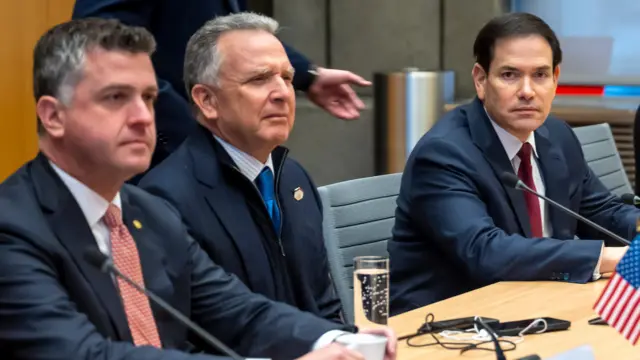
US Secretary of State Marco Rubio came out of hours of talks to announce “tremendous progress”, as he put it, and insist that there were just “a couple of issues” that would be resolved.
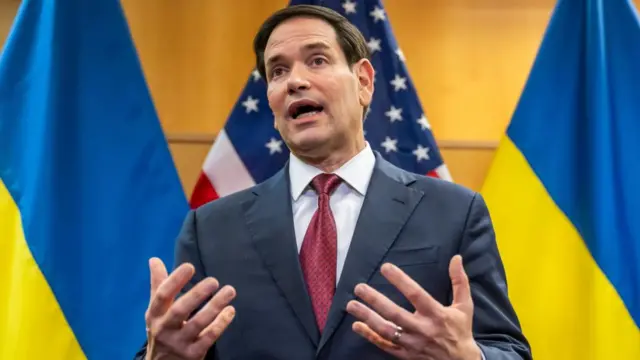
But he wouldn’t go into any details – and other reports suggest European officials have helped Kyiv push back against some key points of his proposed peace deal.
The first draft was so heavily skewed in favour of Russia, Rubio had to confirm that it had been written by Washington and not by the Kremlin.
Ukraine is engaging with this process, because it can’t afford to lose US support – and because Kyiv really does want peace.
But there is one demand on which it can’t compromise: Ukraine needs the US to give the most robust possible security guarantees, so that once this war is over, Russia never dares invade again. And it doesn’t have that yet.
Rubio said he would “love” an agreement to be reached by Thursday, when the US celebrates Thanksgiving, as Donald Trump initially demanded. But he said the new deadline was “as soon as possible”.
Welcome back to our live coverage, after US and Ukrainian negotiators held talks in Geneva on a peace plan to end the war with Russia.
Overnight, the US and Ukraine released a joint statement describing the meeting as “highly productive”. A separate report from the White House said “the meeting concluded with a shared understanding that today marked a significant step forward”.

The 28-point plan, which emerged last week, has been cautiously welcomed by Russia, but not by leaders in Kyiv and Europe, who see it as too favourable to the Kremlin.
A White House report of the Geneva talks says that “based on the revisions and clarifications presented today,” the Ukrainians “believe the current draft reflects their national interests”.
US Secretary of State Marco Rubio says there is “still some work to be done”, while Ukrainian President Volodymyr Zelensky says there are “signals that President [Donald] Trump’s team is hearing us”.
While the draft of the US-backed plan has not been published in full, major details have leaked in recent days.
This morning we’ll bring you all the reaction to the talks, as well as analysis on what’s happened so far and what could come next.
US Secretary of State Marco Rubio says he is “very optimistic” about talks aimed at ending the Russia-Ukraine war after a “very good day” in Geneva.
A Ukrainian delegation has been holding talks with teams from the US and European allies, amid pressure from the White House to agree a 28-point plan which critics have argued would reward Russia for its invasion with territory and other concessions.
Days before the talks Ukrainian President Volodymyr Zelensky said his country could face losing either its dignity or US support.
An outburst from President Donald Trump on Sunday – accusing Ukraine of showing “zero gratitude” for US efforts to end the war – suggested the talks were not going well.
Earlier in the day, a group of US senators said they had been told the plan under discussion had been effectively drawn up by Russia – which Rubio denied.
But after a meeting of high-level officials from the US and Ukraine – including Trump’s son-in-law and Zelensky’s right-hand man – Rubio said he believed substantial progress had been made.
He said some issues remain outstanding – without giving details – but said the US wants a deal done as soon as possible, and suggested an agreement with Ukraine could be made in a matter of days.
Zelensky, posting on social media, was slightly more guarded, welcoming the “reinvigorated” diplomacy and saying there are signals Trump’s team “is hearing us”.